Boris Johnson’s upbeat speech at the Munich conference on security could not have been clearer about his Government’s theatre of engagement - “the security of our homeland and the stability of the Euro-Atlantic area”.
It called out Russia’s terrorism in Salisbury and pointed to “the biggest increase in our defence budget since the Cold War” - taking in, during its tour of the course, post-Covid resilience and two diplomatic showcases for Britain this year: our presidency of the G7 and the COP26 summit on the environment
The Prime Minister also showed how much more congenial the Biden administration was, in most respects, to him than its Trumpian predecessor, citing Iranian policy as well as climate change.
Indeed, one of the main purposes of the speech was to row in behind the new president’s push for an alliance of democracies to counter the influence of China. Biden wants a summit for democracy and Johnson is pushing for a D10 group of democracies, an idea favoured by his foreign affairs adviser, John Bew.
“I have invited South Korea, and Australia and India to attend the next G7 summit as guests, alongside leading international organisations,” he said. You can work out for yourself what seven plus three equals.
To this purpose, Johnson stepped outside his Euro-Atlantic theatre to tilt at China over its heinous treatment of the Uighars. This Islamic reference takes us to a remarkable omission in his speech - and, no, it wasn’t the absence of anything bar the most cursory references to the European Union.
Theresa May’s speech to the same conference in 2018 - the Munich Security Conference is a regular feature of the international diplomatic calendar - was peppered with citings of Islamist extremism.
The previous year had seen the attack on Westminster Bridge in which four people, including Keith Palmer, a police officer, were killed and almost fifty injured; a copycat assault later in the year - and, between them, the Manchester Arena murders and the London Bridge atrocity, which weakened her already tottering general election campaign.
David Cameron’s similar address in 2014 had been a landmark event, setting out a framework for action that targeted non-violent Islamist extremism as well as its violent product.
His argument was that, to borrow a picture from Michael Gove, if one wanted to get rid of the crocodiles it was necessary to drain the swamp. There was a ferocious fightback against the speech in parts of Whitehall: Charles Farr, then director of the Office for Security and Counter-Terrorism, dismissed it as a “personal view” rather than a statement of Coalition policy.
To those engaged in the debate, the quarrel brings back the flavour of the years that separate 9/11 from today: 7/7/, Abu Hamza, the Iraq war, Abu Quatada, the murder of Lee Rigby, ISIS - all jumble together like a collage on a teenager’s wall.
Here at home, Labour and Conservative governments variously initiated and overhauled the Prevent Strategy, rushed through anti-terror legislation and appointed a reviewer of it, slapped a ban on engagement with non-violent Islamist organisations that is still fitfully applied, and appointed a Commissioner for Countering Extremism who is still discreetly in place.
Why did the Prime Minister omit all but the most oblique of references to the phenomenom which gripped our political culture for the best part of 15 years, putting Britain’s Muslims in the spotlight for the first time since the Satanic Verses?
ConservativeHome gathers that the absence was accidental, and that in itself tells one a great deal. The simple fact is that Islamist terror, though still a terrible fact worldwide, is ebbing, at least in terms of its capacity to make an impact and grab media attention here in Britain. Bin Laden is dead. ISIS is defeated, in the sense of losing the territory it gained in Iraq and Syria.
Success proved the most effective recruiter for the Islamist terror groups who acted abroad and recruited here - sometimes returning their jihadis home in due course.
Failure has lessened the flow and spycraft has restricted opportunities here. The security services have had many successes that don’t get reported and these must be balanced against the failures that do (as in the case of the 7/7 gang and Lee Rigby’s murderers). We are all in their debt.
In retrospect, was our security policy well-targeted? Did it not so much take out crocodiles from the swamp, let alone drain it, as stir up a hornet’s nest? Was the tilting against sharia hysterical?
It proved impossible in Northern Ireland to act militarily against the IRA without alienating a slice of the nationalist population. Our take is that the same outcome was intrinsic to anti-terrorism measures here that targeted Islamist terror groups, and that it is impossible to suppress them without also estranging a segment of British Muslim opinion.
The art is to minimise the alienation while simultaenously maximising the action. Did government always get it right? No. Did some British Muslims misread Ministers? Yes. Did foreign policy alientate them? Yes. Was it the sole cause of Islamist extremism here? No.
Was it even the main cause? We don’t think so. Meanwhile, other countries are more outspoken about the Islamist threat, and their security forces less inhibited than our own. Emmanuel Macron’s France, drawing on its secularist tradition, is a classic example. But there is no evidence that its approach has been more successful than ours.
At any rate, the absence of references to Islamist extremism from Johnson’s speech is a sign of changing political weather. Perhaps we are collectively incapable of thinking about more than one security menace at once.
Fox hunting may be banned but its political equivalent goes on still. The pack is in full cry as it pursues China over the Uighars and atrocities (and showing Britain’s Muslims that others care about it is a useful counter to claims of anti-Muslim prejudice).
Over the horizan it vanishes in pursuit of the prey. As it does so, do other foxes hear the hoofbeats vanish, stir in their lairs, and cock an ear? We can’t assume that this isn’t happening. No-one much saw Al Qaeda in the undergrowth before 2001. Nine-eleven came out out of a clear blue sky.
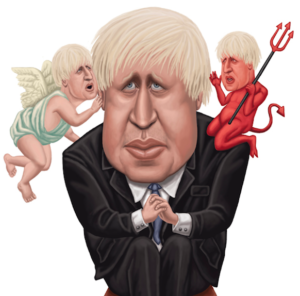 “Bitter Tory in-fighting broke out last night after a Conservative-friendly think-tank demanded an inquiry into the power of Boris Johnson’s fiancee, Carrie Symonds. Ben Harris-Quinney, chairman of the Bow Group – which boasts Tory heavyweights Norman Tebbit and Norman Lamont among its patrons – called for an independent investigation into the influence that Ms Symonds exerts in Downing Street. Allies hit back to insist that it was normal for a Prime Minister to consult his partner, not least because Ms Symonds is a former director of communications for the Tory Party. And senior Tory MP Sir John Redwood, another of the think-thank’s patrons, disowned the Bow Group’s intervention, dismissing it as a ‘very bad idea’. He told The Mail on Sunday: ‘The PM is responsible for who advises him and he is quite entitled to take advice from anybody he likes.’” -
  “WHEN the PM said in January that his roadmap out of lockdown would allow us to “reclaim our lives once and for all”, he created the spirit of hope and optimism that powered him to a brilliant election victory just over a year ago. Covid is a serious disease and we must control it. However, just like Covid, lockdowns and restrictions cause immense social and health damage, with a huge impact on people’s livelihoods. For most of the past year the Government has been taking big decisions and asking us to change our lives so we could all do our bit to protect the NHS and save lives. Now that vaccines are here, we can achieve those aims through vaccination, rather than lockdowns or restrictions.” -
  “Rishi Sunak is to put Britain on course for an increase in business taxes to pay for an extension to Covid-19 support schemes in the budget next month. The chancellor will announce that he is increasing corporation tax from 19p in the pound in his speech on March 3 and will outline a pathway where it keeps rising to 23p in the pound by the time of the next general election — a move that will raise an expected £12 billion a year. At least 1p is set to be added to the bill for business from this autumn, at a cost to business of £3bn, with further rises in subsequent years. That will help to pay for an extension to the furlough scheme, VAT
 “As flights of political fancy go, Boris Johnson’s desire to build a tunnel between Great Britain and Northern Ireland might seem to be one of the most audacious. However, Whitehall officials have revealed that one version of the plan worked up in Downing Street went even further, envisaging not one but three tunnels under the Irish Sea connecting in an “underground roundabout” beneath the Isle of Man. No 10 officials given the task of examining how Johnson’s blue-sky thinking might be feasible quickly concluded that the original plan of a link between Stranraer in Scotland and Larne in Northern Ireland was impractical.” -
  “Ministers have hailed a new Brexit dividend by scrapping ‘insane’ new EU rules that would have required ride-on mowers, golf buggies and mobility scooters to be insured. A judgment passed by the European Court of Justice (ECJ) would have widened the number of vehicles that require insurance, but Transport Secretary Grant Shapps is to shelve the ‘over the top’ rules. Officials said introducing the law would have had the knock-on effect of hitting British drivers with a £50 average hike in annual car insurance premiums. Mr Shapps said: ‘We have always disagreed with this over-the-top law that would only do one thing – hit the pockets of hard-working people up and down the country with an unnecessary hike in their car insurance.” -